
Share proton therapy across national borders and plan five new centres in Romania, Greece, Italy, Northern Ireland and Poland to maximise access for patients in Europe
— Researchers working to make proton beam therapy safe and effective for pregnant cancer patients —
Stockholm, Sweden: Existing proton therapy centres mean that 59% of cancer patients across Europe currently have reasonable access to this specialist radiotherapy, according to research that will be presented the Congress of the European Society for Radiotherapy and Oncology (ESTRO 2026) [1].
The study shows that allowing patients access to proton therapy across national borders would immediately increase this coverage to 65%. With the addition of new centres already planned plus five extra centres strategically placed across the continent, 87% of the European population would be within reach of a centre by 2030.
In a second study, that will also be presented at ESTRO 2026 [2], researchers have looked and when and how proton therapy is being used to treat pregnant cancer patients, and what steps must be taken to ensure treatment is effective while protecting the unborn baby.
Giving more patients access to proton therapy
The first study will be presented by Dr Dominik Wawrzuta, a radiation oncologist at the Maria Sklodowska-Curie National Research Institute of Oncology, Warsaw, Poland. He said: “Proton therapy is a specialised form of radiotherapy. It targets tumours with protons, instead of X-rays used in conventional radiotherapy. There are some patients who can particularly benefit from proton therapy, and this includes some children with cancer and patients with tumours that are difficult to reach or are growing very close to delicate organs like the eye, brain and spine.
“Because proton therapy machines are expensive to build and run, they are currently only available at 29 centres across Europe. We wanted to investigate what this means for patients’ access to proton therapy and to look at how we can make this treatment available to more patients in the future.”
The research included data on all countries in the European Economic Area plus the UK and Switzerland. Researchers used mapping to show what percentage of the population in these countries can currently reach a proton therapy centre in their country within four hours’ drive. They compared this to the percentage within four hours’ drive of a proton therapy centre in any country and regardless of national borders, showing that access could immediately be improved from 59% to 65%, equating to an additional population of 32 million people.
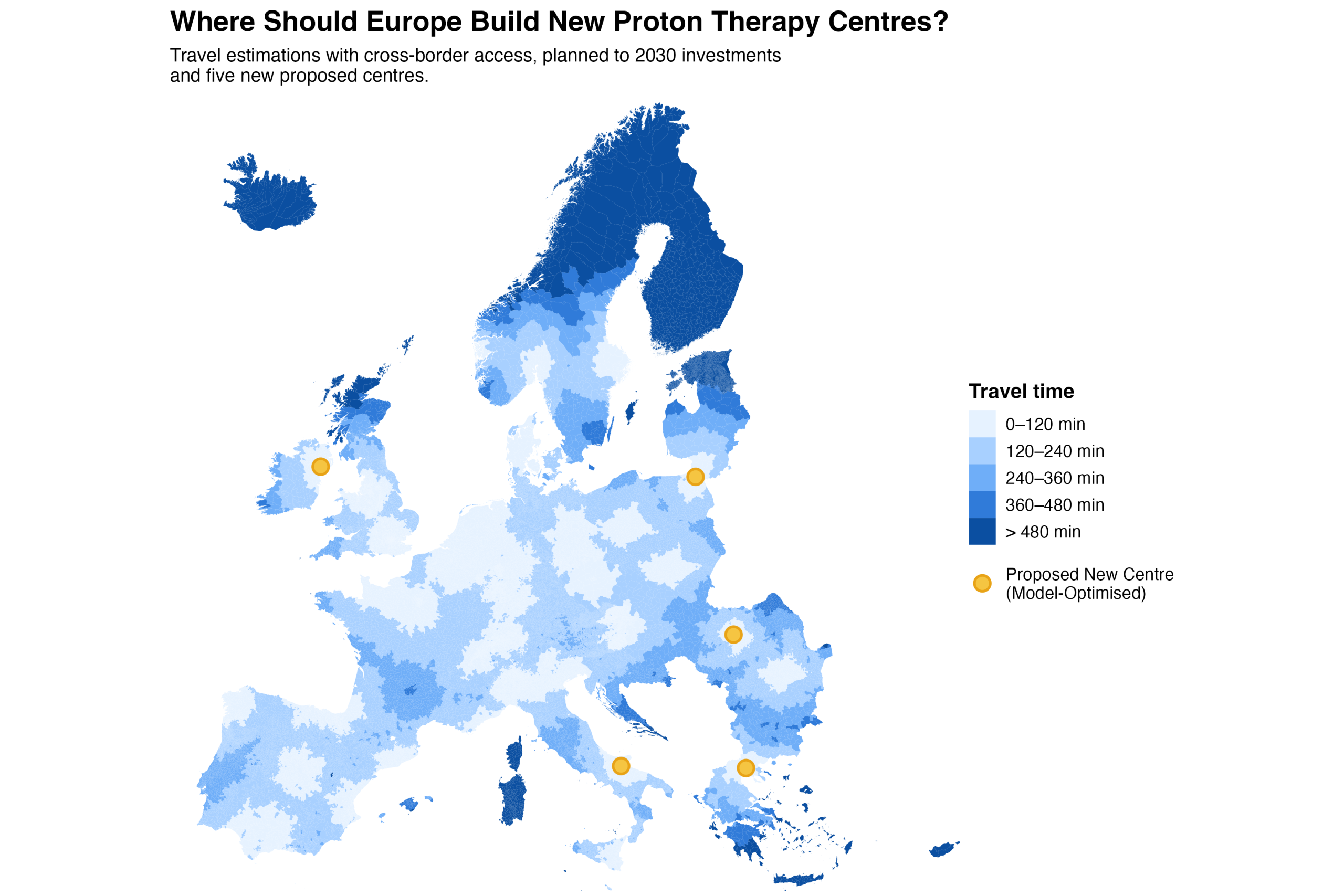 Researchers then looked at how this was set to improve by 2030, when an additional 21 new centres that are already planned will be open. They found that this resulted in 80% of the population being within a four-hour drive of a proton therapy centre. However, this also highlighted several major gaps. They showed that access could reach 87% of the population by 2030, if just five additional centres were planned. To reach areas that currently do not have good access to proton therapy centres, and to cope with the increase in demand expected with a continuing rise in cancer cases, the researchers say these centres should be opened in Northwestern Romania, Northern Greece, Southern Italy, Northern Ireland and Northeastern Poland.
Dr Wawrzuta said: “This research highlights that where you live can significantly influence whether you can realistically access proton therapy when it might be beneficial. We found that even when a country has a facility, significant inequalities in geographic access can still exist. While some patients can reach the centre relatively quickly, others may need to travel many hours for treatment, creating financial, social, and emotional burdens during an already difficult time.
“Improving access is not just about building more centres, but also about building them in the right locations. Strategic planning should aim to increase overall capacity and actively address existing inequalities in access. Our study provides a practical, data-driven approach to identify where new investment would have the greatest impact on both capacity and equity of access.”
Safer proton therapy for pregnant cancer patients
The second study was carried out by a team of European researchers and will be presented by Dr Maite Romero-Expósito, a researcher in the Medical Radiation Physics group at Stockholm University, Sweden. The team carried out a survey of when and how proton therapy is being used to treat pregnant cancer patients in Europe.
Dr Romero-Expósito said: “Cancer during pregnancy is relatively rare, and the probability of encountering a case that requires radiotherapy is even lower. However, when such cases occur, each situation must be carefully evaluated.
“With proton therapy, the radiation dose outside the tumour target is significantly lower compared with conventional radiotherapy. This makes it a promising clinical alternative for treating pregnant patients more safely while minimising dose to the foetus. Nevertheless, a full and accurate evaluation of all radiation that could be received by the foetus remains essential.”
The research identified 26 cases where proton therapy has been used to treat pregnant patients. Most were treated for cancers located in the head, neck or chest with treatment usually taking place in the third trimester.
Experts who responded to the survey emphasised the need for evaluating current practice for this patient group, in particular ensuring careful planning and measurement of the radiation outside the area being treated. As a result, the researchers have developed guidance and checklists to support imaging, treatment planning and dose assessment for pregnant patients in the future.
Dr Romero-Expósito said: “Given the rarity of these cases, sharing expertise is essential. This work will ensure that pregnant patients can benefit from proton therapy treatments if they need it, while also providing precise information on the level of foetal exposure, thereby enabling well-informed clinical decision-making.”
Maximising the benefits of proton therapy
ESTRO President-Elect Professor Barbara Jereksek-Fossa, from the University of Milan and the European Institute of Oncology, Italy, who was not involved in either study said: “Radiotherapy is a vital part of treatment for more than half of all cancer patients. All forms of radiotherapy work by carefully targeting tumours with radiation, helping to destroy cancer cells while avoiding the surrounding healthy tissue. This means more patients survive cancer and do so with minimal side-effects.
“Proton therapy is a form of radiotherapy that uses a proton beam instead of X-rays. There are some patients for whom proton therapy is particularly helpful and this includes some types of childhood cancer, cancers in delicate organs, like the eye and brain, and potentially cancers in patients who are pregnant.
“Dr Wawrzuta’s research reveals where proton therapy is and isn’t available to cancer patients across Europe. This mapping of proton therapy services shows how sharing resources between countries and strategic planning for the locations of new centres could make this treatment available to the vast majority who need it.
“Dr Romero-Expósito and her colleagues have carried out an important assessment of how proton therapy is already being used to treat cancer in pregnant patients and, crucially, what extra precautions should be taken in the future to treat pregnant patients and protect their unborn babies.”
(ends)
Notes to editors
Please acknowledge ESTRO 2026 as a source in any articles:
[1] Abstract number 3278, ‘Geographic accessibility of proton therapy services in Europe: current status and opportunities for enhancement’, by Dominik Wawrzuta et al, in session: ‘Safeguarding access to radiation oncology’, room T1, 10:30-11:30 hrs CEST, Monday 18 May, https://www.estro.org/Congresses/ESTRO-2026/3118/safeguardingaccesstoradiationoncology
Funding: This study received no external funding.
[2] Abstract number 1522, ‘Status and practice of proton therapy for pregnant patients in Europe’, by Maite Romero-Expósito et al, in session: ‘Highlights in particle therapy: Clinical translation, quality and robustness’ room A10, 10:30-11:30 hrs CEST, Sunday 17 May, https://www.estro.org/Congresses/ESTRO-2026/3131/highlightsinparticletherapy-clinicaltranslation-qu
Funding: There is no external funding at this stage. The task force was initiated through the collaboration of members from the European Particle Therapy Network (EPTN) and the European Radiation Dosimetry Group (EURADOS).